


A patient shows up fifteen minutes early for an appointment, fills out the same paper form she’s filled out four times before at the same clinic, waits another twenty minutes past her scheduled time, and leaves feeling like nobody there actually knows anything about her beyond what’s on that clipboard. None of this is a clinical failure. The care itself might be excellent. But it’s exactly the kind of friction that’s pushing clinics and hospitals to work with a Healthcare Applications Development company, because patients increasingly judge a provider on the whole experience, not just the quality of the diagnosis at the end of it.
Patient experience used to mean bedside manner and maybe a comfortable waiting room. It means something bigger now how easy it is to book something, how much repeating yourself you have to do, whether anyone actually got back to you about that test result. Mobile apps have quietly become the tool clinics use to fix a lot of this at once.
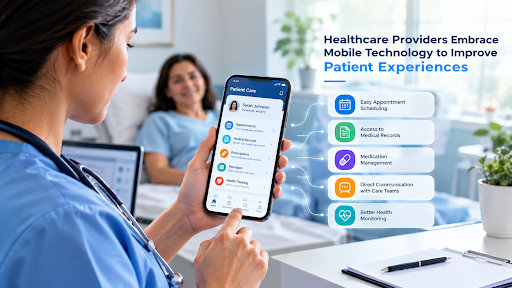
Registration is usually the first thing patients notice, and it’s often the worst part of a visit. Filling out the same information over and over, on paper, in a waiting room, is tedious and it signals that the systems behind the scenes aren’t talking to each other. Apps that let patients pre-register, upload insurance details, and update their history before they even walk in remove a huge chunk of this friction. Nobody wants to spend the first ten minutes of a visit writing down their own birthdate for the fourth time.
Wait times are the other big one. A lot of clinics have gotten decent at estimating how long a visit will actually take, and apps that show patients a real-time queue position, or send a text when the doctor’s running behind, change the whole feel of waiting. People don’t mind delays nearly as much when they know what’s happening. What they hate is sitting there with no information, wondering if they’ve been forgotten.
Communication after the visit matters just as much, maybe more. A lot of patient anxiety isn’t about the appointment itself, it’s about what happens after waiting on a test result, not knowing if a message got through to the doctor, wondering whether a symptom is worth calling about. Apps with direct messaging let patients ask a quick question without booking an entire appointment for it, and that alone changes how connected people feel to their own care.
There’s also something to be said for apps that just remember things. A patient shouldn’t have to re-explain a chronic condition or a medication allergy every single visit. When an app surfaces that history automatically for the provider, and lets the patient see their own records too, it removes a small but real source of frustration that builds up over years of visits.
Telehealth has folded into this in a way that feels less like a separate feature now and more like just another option sitting next to in-person booking. For a lot of routine follow-ups, a five-minute video call beats a half-day off work and a commute across town, and patients have gotten pretty vocal about wanting that choice available by default rather than something they have to specifically ask for.
None of this is free, obviously, and clinics thinking about building or upgrading their own app need a realistic sense of Healthcare App Development Cost before they commit to anything. A basic scheduling and messaging app costs a lot less than something integrating wearable data, AI-driven triage, and full electronic health record syncing, and most providers are better off scoping something smaller and useful first rather than trying to build everything at once and running out of budget halfway through.
What actually makes patients like using these apps, though, isn’t the feature list. It’s whether the thing feels simple. A confusing app with twelve menus and a login that never quite works ends up worse than no app at all, because now patients feel like they’ve been handed one more chore. The clinics getting this right tend to keep things narrow at first booking, messaging, records access and build outward from there once people are actually using it.
There’s a business case buried in all of this too, even though it’s easy to talk about patient experience like it’s purely about kindness. Patients who feel like a provider respects their time tend to stick around, refer friends, and show up for their follow-ups instead of skipping them. Fewer no-shows, fewer angry phone calls to the front desk, less staff time spent chasing down information that should’ve been in the system already. Better experience and better operations end up being the same investment, most of the time.
Where this heads next probably looks like deeper personalization apps that adjust reminders and communication style based on how a specific patient actually responds, rather than sending the same generic notification to everyone. Expect tighter integration between the app and whatever the clinic’s actual records system is, so patients stop feeling like they’re bouncing between disconnected pieces of the same provider.
Healthcare has always had a slightly awkward relationship with convenience there’s a sense that care should be serious, not smooth, and that friction is just part of the deal. Patients don’t see it that way anymore. The providers doing well here aren’t necessarily the ones with the flashiest technology. They’re the ones that looked honestly at where their own patients get frustrated and quietly fixed it, one annoying step at a time.